How Private Real Estate Transactions Are Structured

Private real estate transactions are often misunderstood as informal or loosely organized. In reality, when executed properly, private transactions are highly structured, disciplined, and professionally coordinated. The difference lies not in the absence of process, but in the control and selectivity applied throughout the transaction lifecycle.
Understanding how private real estate transactions are structured helps property owners and buyers evaluate whether a confidential approach aligns with their objectives and expectations.
The Foundation: Clear Objectives and Alignment
Every private real estate transaction begins with clarity. Before any outreach or negotiation occurs, ownership objectives must be defined. This includes considerations such as pricing expectations, timing, confidentiality requirements, and acceptable deal structures.
Private transactions are most effective when goals are realistic and aligned from the outset. Without this foundation, even the most discreet process can become inefficient or unproductive.
Confidential Property Review and Positioning
Once objectives are established, the next step is a confidential review of the asset. This review assesses property fundamentals, market context, and transaction feasibility without exposing the opportunity publicly.
Positioning in a private transaction is tailored to the asset rather than standardized marketing templates. Information shared privately is relevant, complete, and credible.
Selective Buyer or Capital Alignment
Rather than broadcasting an opportunity to the broader market, private transactions rely on selective alignment with qualified buyers or capital groups. These parties are chosen based on demonstrated capability, intent, and alignment with the transaction parameters.
This selectivity improves efficiency and protects confidentiality while fostering substantive, focused discussions.
Structured Negotiation and Term Development
Negotiations in private transactions are typically more deliberate. Without public bidding pressure, parties can focus on structure as well as price, addressing timing, contingencies, and flexibility.
Effective negotiations remain disciplined and clearly defined to avoid misalignment.
Due Diligence and Documentation

Once preliminary terms are agreed upon, the transaction moves into due diligence. This phase includes financial review, legal analysis, inspections, and regulatory considerations.
Due diligence in private transactions is often more focused, as alignment has already been established.
Escrow, Closing, and Execution
The final phase involves escrow coordination, title review, and closing. Professional execution ensures obligations are met and timelines maintained.
The process remains consistent and intentional through completion.
The Role of Professional Coordination
Private real estate transactions require experienced coordination to maintain structure and momentum. Professional oversight ensures counterparties remain aligned and execution remains disciplined.
Aurafield Property Exchange Group™ coordinates private and off-market real estate transactions with a focus on structure, discretion, and professional execution.
A Structured Alternative, Not a Shortcut
Private transactions are not shortcuts. They are structured alternatives designed for situations where discretion, control, and alignment matter more than broad exposure.
Closing Perspective
Understanding private transaction structure sets realistic expectations and enables informed decision-making. When alignment, discipline, and coordination are present, private real estate transactions can be highly effective.

Why Property Owners Choose Confidential Transactions Over Public Listings

Not every property owner benefits from placing a real estate asset into the public market. While public listings play an important role in many transactions, they are not universally appropriate. For certain ownership situations, asset types, and strategic objectives, a confidential transaction framework can provide advantages that public marketing cannot.
Confidential real estate transactions—often conducted off-market—are chosen not to avoid transparency, but to maintain control, discretion, and strategic flexibility. Understanding why property owners opt for this approach helps clarify when confidentiality is a strength rather than a limitation.
The Nature of Public Listings
Public listings are designed to maximize exposure. By placing a property on the MLS or similar platforms, ownership invites broad market participation, competitive bidding, and public price discovery. In many cases, this exposure is beneficial and appropriate.
However, public listings also introduce external pressures. Once a property is publicly marketed, ownership loses a degree of control over how information is interpreted, shared, and speculated upon. Pricing becomes visible, timing becomes scrutinized, and negotiations often play out under market observation.
For some owners, these dynamics are acceptable. For others, they introduce risks that outweigh the benefits of broad exposure.
Confidentiality as a Strategic Choice
Confidential transactions are often misunderstood as secretive or evasive. In reality, they are typically intentional and strategic.
Property owners may choose confidentiality to protect personal privacy, operational stability, or long-term value. Public listings can disrupt tenants, employees, or business operations, particularly when properties are income-producing or tied to ongoing enterprises.
Confidentiality allows owners to explore options without triggering unnecessary consequences. It preserves optionality and ensures that decisions are made deliberately rather than reactively.
Preserving Pricing and Negotiation Leverage
Public listings often create immediate reference points for value. Once a price is visible, it becomes a benchmark that can be difficult to adjust without signaling weakness or urgency.
In a confidential transaction, pricing discussions occur privately and contextually. Rather than reacting to public opinion, owners and buyers can negotiate based on asset fundamentals, structure, and long-term objectives.

Confidential negotiations also reduce the risk of deal fatigue, where prolonged public exposure leads to repeated offers, withdrawals, or price reductions that erode credibility.
Controlling the Buyer Audience
Public listings invite a wide range of inquiries, many of which may not be serious, qualified, or aligned. While broad exposure increases visibility, it can also consume time and attention without producing viable outcomes.
Confidential transactions prioritize selectivity over volume. Opportunities are introduced only to buyers or capital groups that meet specific criteria and demonstrate the capacity to execute.
For property owners, this often results in fewer conversations—but better ones.
Timing, Certainty, and Execution
In some situations, speed and certainty matter more than maximizing exposure. Owners may face timing considerations related to financing, portfolio strategy, succession planning, or market conditions.
Confidential transactions allow timelines to be structured deliberately. Without public marketing deadlines or open-ended exposure, parties can align expectations around due diligence, approvals, and closing with greater precision.
Complex or Non-Standard Assets
Not all properties fit neatly into standard listing categories. Assets with complex ownership structures, specialized uses, redevelopment potential, or transitional characteristics often require context that public listings cannot easily convey.
Confidential transactions allow these nuances to be addressed directly. Buyers can receive detailed information privately, ask informed questions, and assess opportunities without the constraints of standardized marketing formats.
Avoiding Market Signaling
Public listings signal intent. Once a property is listed, the market assumes a willingness to sell under defined terms. If a transaction does not proceed, that signal can linger.
Confidential transactions avoid premature signaling. Ownership can explore interest, test assumptions, and evaluate options without committing publicly.
When Confidential Transactions May Not Be Appropriate
Confidentiality is not always the best path. Properties that benefit from broad exposure, competitive bidding, or transparent price discovery may perform better in a public listing environment.

A credible advisor recognizes these distinctions and does not default to confidentiality in every situation.
A Disciplined, Professional Framework
Confidential transactions require structure and professional oversight. Without clear process, private negotiations can drift or lose alignment.
Aurafield Property Exchange Group™ coordinates confidential and off-market real estate transactions with a focus on discretion, structure, and professional execution. Each opportunity is evaluated individually to determine whether a confidential framework aligns with the owner’s goals.
Closing Perspective
Property owners choose confidential transactions not to avoid the market, but to engage with it on their own terms. When discretion, control, and execution certainty matter, confidentiality can provide a powerful alternative to public listings

What Is an Off – Market Real Estate Transaction?

What Is an Off-Market Real Estate Transaction?

In real estate, not every transaction occurs in public view. Many property owners and buyers choose to engage in transactions that are negotiated privately, outside of public listing platforms. These transactions are commonly referred to as off-market real estate transactions.
An off-market real estate transaction is a sale or acquisition that is conducted without being advertised on the Multiple Listing Service (MLS) or other public marketing channels. Rather than broad exposure, off-market transactions rely on direct communication, targeted outreach, and confidential negotiation between qualified parties. This approach is widely used across residential, commercial, and mixed-use assets when discretion, control, or execution certainty is a priority.
Off-market transactions are not a new concept. They have long been used by institutional investors, family offices, developers, and high-net-worth property owners who require a more controlled transaction environment. In many cases, the most significant real estate transactions never appear in public listings at all.
Why Off-Market Transactions Exist
Off-market transactions exist because public listings are not always the most efficient or appropriate path for every property or ownership situation. While public marketing can generate visibility, it can also introduce noise, speculation, and pressure that may not align with an owner’s objectives.
Confidentiality is often a primary driver. Property owners may wish to avoid public attention for personal, operational, or financial reasons. Public listings can disrupt tenants, employees, or business operations, and they may invite unsolicited inquiries that consume time without producing serious outcomes.
In other cases, owners want to explore value without signaling intent to sell publicly. An off-market approach allows ownership to test interest, evaluate terms, and assess market appetite without committing to a formal sale process.
From a buyer’s perspective, off-market transactions can provide access to opportunities that are not subject to competitive bidding or broad exposure. This can create a more disciplined negotiation environment, particularly when capital is aligned early in the process.
How Off-Market Transactions Typically Work
While each transaction is unique, off-market real estate transactions generally follow a structured framework designed to protect all parties involved.
The process often begins with a confidential property review. Ownership objectives, asset characteristics, and market context are evaluated to determine whether an off-market approach is appropriate. Not every property benefits from a private transaction strategy, and part of a disciplined process is identifying when discretion adds value and when it does not.

Once suitability is established, the opportunity is aligned selectively with qualified buyers or capital groups. Rather than broadcasting the asset publicly, outreach is targeted toward parties with demonstrated interest, capability, and alignment. This reduces friction and minimizes unproductive conversations.
Negotiations occur directly between parties, allowing flexibility around pricing, structure, timing, and terms. Because exposure is controlled, discussions tend to be more deliberate and focused, which can preserve leverage and reduce volatility.
Once terms are agreed upon, the transaction proceeds through escrow, title, and closing with appropriate legal and professional oversight. The execution phase is managed with the same discipline as a publicly listed transaction, with added emphasis on confidentiality and clarity.
Who Off-Market Transactions Are Best Suited For
Off-market transactions are commonly used by property owners and buyers who prioritize discretion, control, and execution certainty.
These transactions are well suited for high-value assets, complex ownership structures, or properties that require specialized buyers. They are also frequently used by owners who are not under immediate pressure to sell but are open to exploring strategic opportunities.
Investors and capital groups with defined acquisition criteria often prefer off-market opportunities because they allow for targeted alignment rather than broad competition. In these cases, efficiency and certainty may outweigh the benefits of mass exposure.
It is important to note that off-market transactions are not inherently superior to public listings. They are simply a different tool, best used when circumstances warrant a private approach.
When an Off-Market Approach Makes Sense
An off-market transaction may be appropriate when confidentiality is a priority, when pricing sensitivity exists, or when timing and execution certainty are critical. It may also be suitable when an asset does not fit neatly into traditional listing categories or when ownership seeks flexibility in deal structure.
Conversely, properties that benefit from maximum visibility, broad buyer competition, and transparent pricing discovery may perform better in a public listing environment. A
disciplined advisor will recognize this distinction and recommend the appropriate path based on the specific situation.

The key is not choosing off-market or on-market by default, but selecting the framework that best aligns with ownership objectives and market conditions.
The Importance of Structure and Professional Coordination
Successful off-market transactions require structure, experience, and professional coordination. Without a defined process, private negotiations can lead to misalignment, stalled discussions, or incomplete execution.
Professional coordination ensures that opportunities are presented accurately, counterparties are qualified, and negotiations remain focused. It also ensures that once terms are agreed upon, the transaction proceeds smoothly through escrow and closing.
Aurafield Property Exchange Group™ coordinates off-market and privately negotiated real estate transactions with a focus on discretion, structure, and professional execution. Each opportunity is evaluated individually to determine whether a private transaction framework is appropriate.
A Balanced Perspective
Off-market transactions are not about avoiding transparency or bypassing standards. They are about choosing the right framework for the situation at hand. When used thoughtfully, they can provide flexibility, control, and efficient outcomes that public listings may not always deliver.
At the same time, they require discipline, patience, and professional oversight. Not every opportunity belongs off-market, and recognizing that distinction is part of a credible, trust-based approach.
Closing Thoughts
Off-market real estate transactions represent a powerful alternative to traditional public listings when discretion, control, and execution certainty matter. Understanding how they work, when they make sense, and who they serve allows property owners and buyers to make informed decisions aligned with their objectives.
Whether an opportunity ultimately proceeds privately or publicly, a structured, professional evaluation is the foundation of a successful outcome

Stranger Things in the feed: When audiences take control

[ad_1]


Strange things happen not only on the screen. They unfold in social feeds, where audiences increasingly shape narratives in real time. From fandom-driven belief systems and breaking news cycles to platform changes and AI-powered discoveries, engagement is no longer passive. As control shifts away from institutions and toward interpretation, clarity, restraint, and trust have become the Internet’s most valuable currencies.

[ad_2]

Source link

Should I Sell My House Now?

[ad_1]

Main conclusions:

  • This is a good time to sell your home if you have priced it right and are ready to negotiate.
  • Mortgage rates settled at near 14-month lows, leaving the door open for deflated buyers to re-enter the market.
  • There is much more home sellers than buyers, tipping the scales toward buyers, but sellers can still get competitive offers.
  • Selling now can help you avoid potential price swings if the economy moves toward recession or inflation.

If you are thinking of selling your home, you are not alone. But with today’s almost record housing costs saving everyone on the sidelines, it’s natural to wonder if now is the time.

The typical monthly rent has topped $2,800, and home prices have risen for more than two years in a row. These costs froze the housing market, scaring away buyers and encourage more sellers to do so stay put.

In addition to record spending, President Trump’s policies rattling economy, further weakening of demand. As a result, there are more listings than buyers in the housing market, affecting housing markets across the country.

So what does all this mean for home sellers? Let’s dive into the data that will help you decide whether to sell your home now or wait.

>> Read: How to Sell Your Home in 2025: The Complete Guide

From Redfin’s Chief Economist

Home sellers must prepare for a buyer’s market. Increased inventory has given buyers more options, but near-record costs have made them wary. Low mortgage rates have also not yet brought back buyers. Those who are willing to withstand today’s market are willing to negotiate and pay a fair price.” – Daryl Fairweather, Chief Economist, Redfin.

What sellers need to know about the housing market

Here are some market trends to keep an eye on before finding an agent and listing your home for sale.

Main mainly buyers

On the scale of the country there are over 500,000 more home sellers than buyers. Therefore, to remain competitive, homeowners must be flexible in their pricing and be willing to offer concessions. Many do so, but the share of potential sellers is growing choosing not list or even foreclose on their homes altogether, pushing prices up.

However, trends vary widely across countries. There aren’t enough listings in the Midwest and Northeast to meet demand, so sellers in cities like Rochester and Milwaukee can see the stakes of war and quick sales. On the other hand, most San Belt cities favor buyers as homeowners look to escape worsening climate risks and rising insurance costs.

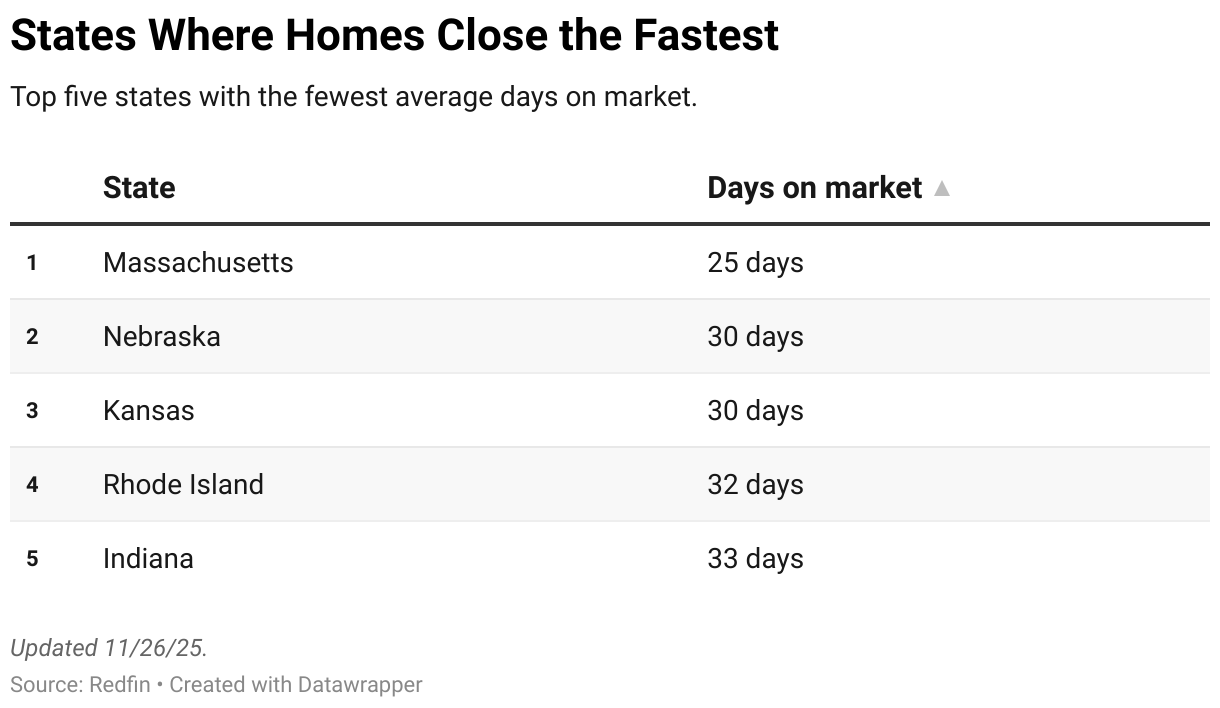
Here are the states where buyers have an advantage, based on days on market. As a rule, the fewer days a house spends on the market, the greater the demand for it.

The economy is unstable

Housing prices are unaffordable, and economists are worried about inflation may increase because of tariffs and immigration policies. Mortgage rates are also unknown, but have been holding steady at ~6.3% since November 2025.

“Mortgage rates are down from last year’s peak, but with home prices at record highs, homebuyers are still struggling in the housing market.” said Chen Zhao, head of economic research at Redfin. “We expect mortgage rates to average 6.3% this year, up from 6.5% in 2025. But until homebuilding booms or the country falls into a major recession, housing affordability and buyer activity are unlikely to improve significantly.

During these uncertain times, it’s important to speak with your agent to decide if now is the right time to sell.

>> Read: How to buy, sell, or rent a home amid economic uncertainty

When is usually a good time to sell a house?

Spring is usually the best time to sell, when buyers are most active. However, market trends and personal opinions matter most.

In today’s market, sellers should prepare for lower demand, plan ahead for their next home, and be realistic about pricing.

Here are some general rules sellers should follow to decide if it’s a good time to sell.


If the housing supply is low

Fewer homes on the market could push prices up and lead to faster sales. That’s the case in many metros today, especially in the Midwest and East Coast, where demand outstrips supply.

When mortgage rates fall

A drop in mortgage rates could cause a surge in buyer demand. More buyers in the market often means higher prices, stronger offers and possible bidding wars – all good news for sellers. When rates drop, sellers need to keep an eye on local market trends.

If you need to sell

Sometimes life demands that you sell. Maybe your family is growing, you need to relocate for work, or you want to be closer to family. In these cases, it may not matter if now is objectively a “good” time to sell.

>> Read: How to sell your house fast – and for more money

When is usually a bad time to sell a home?

You may have no choice but to sell your home, but with these trends in place, you’re less likely to sell quickly or for above market value.


When mortgage rates are high

Higher mortgage rates actually squeeze buyers’ budgets, meaning they get less housing for the same amount of money. It often means fewer, smaller offers. If you can’t get the price you want, it might be worth waiting to sell.

If you recently refinanced

Selling soon after refinancing can wipe out any savings you got from a lower rate, especially when you factor in closing costs and fees. Many sellers today are “tied” to the bid before the pandemic and see no reason to abandon it, although this share the fall.

If your home needs work

A home that needs some love can be harder to sell and may attract lower offers. If you have major repairs on your to-do list, consider tackling them before you list them.

>> Read: 7 Common Home Selling Mistakes and How to Avoid Them

So, should you sell your home now?

If you are financially prepared and have a great agent, now may be a good time to sell your home.

However, home prices are skyrocketing and rising, forcing more and more buyers to wait for a bargain. Sellers don’t have the negotiating power they’re used to, so you may need to offer incentives to attract serious offers.

Home sellers should contact an agentcompetitive prices and be open to offers of concessions. Selling with Redfin gives you access to the highest level of marketing, pre-listing support and award-winning local agents. Qualified Redfin customers can also unlock Preferred price on Rocketa new program to help you save when you buy with Redfin and finance through Rocket Mortgage.

There are always good reasons to sell your home—perhaps you’re moving, downsizing, or hoping to capitalize on your home equity. You may also just need to move. There is no right answer for everyone, but when selling in today’s unpredictable market, timing and strategy are more important than ever.

[ad_2]

Source link

Is Now a Good Time to Buy a House?

[ad_1]

Main conclusions:

  • If you have the funds, now may be a good time to buy a home.
  • Mortgage rates are holding near 14-month lows, offering homebuyers an extended period of affordability.
  • It’s a buyer’s market– there are 530,000 more home sellers than buyers – which gives home buyers an advantage.
  • However, most consumers cautiously due to record high home prices, a sluggish labor market and economic uncertainty leading to a gloomy housing market.

The years may have changed, but the housing market has not. After a very slowly 2025, same thing sluggish tendencies few home sales, limited listings and record high prices persist into the new year. Economic uncertainty adds to the tension.

But there is a silver lining. Mortgage rates have continued to rise for months and are forecast to remain lower in 2026, helping homebuyers afford thousands more than they could last year.

A lot is changing, so it’s no wonder buyers are wondering if now is the time to make the leap.

In short, the right time to buy a home depends on how convenient the time is for you buy a house. Let’s delve into today’s market trends to help you answer the question: Should you buy a home now or wait?

From Redfin’s Chief Economist

Now is a good time to buy a home if you can afford it. Prices continue to rise, pushing people out of the market and giving buyers a bargaining chip. However, a tough economy has everyone on guard, and local housing markets vary widely. Buyers serious about making an offer should check with a local agent and be sure of their finances and future returns.” – Daryl Fairweather, Chief Economist, Redfin.

What buyers need to know about the housing market

Here are some key market trends to keep an eye on to help you make an informed choice when buying a home.

Housing prices are high and may continue to rise

The US median sales price is $429,000, up 0.6% from a year ago. House prices have been rising year-over-year for more than two years and are 30% higher than five years ago.

Since availability was very tight, so were many potential buyers holding on for better deals, causing inventory to build up. Recently, sellers began to notice, p more are pulling their homes off the market in response. This two-stroke dynamic keeps prices higher and reduces demand.

Red-cockaded predicts that prices will rise more slowly this year, which should help improve affordability as wages rise.

>> Read: Redfin Weekly Economic Report

Mortgage rates continue to fall steadily

As of January 6, the fixed 30-year weekly average value mortgage rate sitting at 6.20% – lower than last week and in line with long-term declines.

“Mortgage rates have been hovering between 6.1%-6.3% for several months and we expect this to continue into 2026.” said Chen Zhao, head of economic research at Redfin. “A weak labor market will prompt the Fed to cut interest rates this year, but lingering inflation and the risk of a recession will prevent significant economic improvement. On the positive side, homebuyers are enjoying much lower interest rates than this time last year — when they topped 7% — which should continue into the spring.”

Redfin predicts that mortgage rates will be around 6.3% in 2026.

>> Read: Mortgage rates are falling. Here’s what home buyers and sellers should do about it

How mortgage rates affect home values

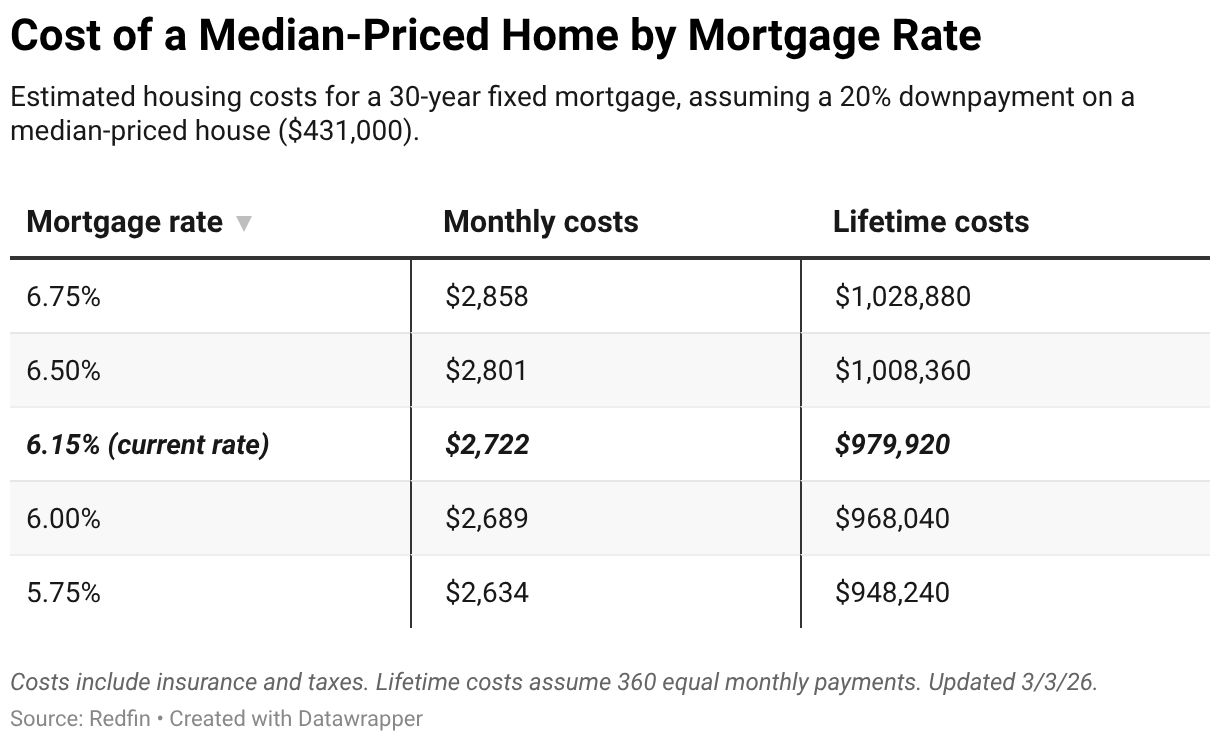
Mortgage rates are important to buyers because they translate directly into monthly housing costs. The higher the rate, the more you pay each month. When rates fall, you can save tens of thousands throughout the life of your mortgage.

Let’s see how your monthly payments change with different rates using our data Mortgage calculator.

Buyers have an advantage

This is the strongest buyer’s market in years: housing inventory got up from post-pandemic lows, especially in the South, giving buyers more bargaining power. However, supplies are still limited in parts of the Midwest and East Coast, putting the onus on retailers. pushing up prices.

Overall, however, high costs are keeping buyers away and freezing home sales. Some households are forced to do great sacrifices such as giving up a pet or delaying a divorce to afford housing. Younger generations suffered particularly hard and often addressing the family for help.

Let’s dig into the data and look at two key market indicators.

Inventory is high but falling

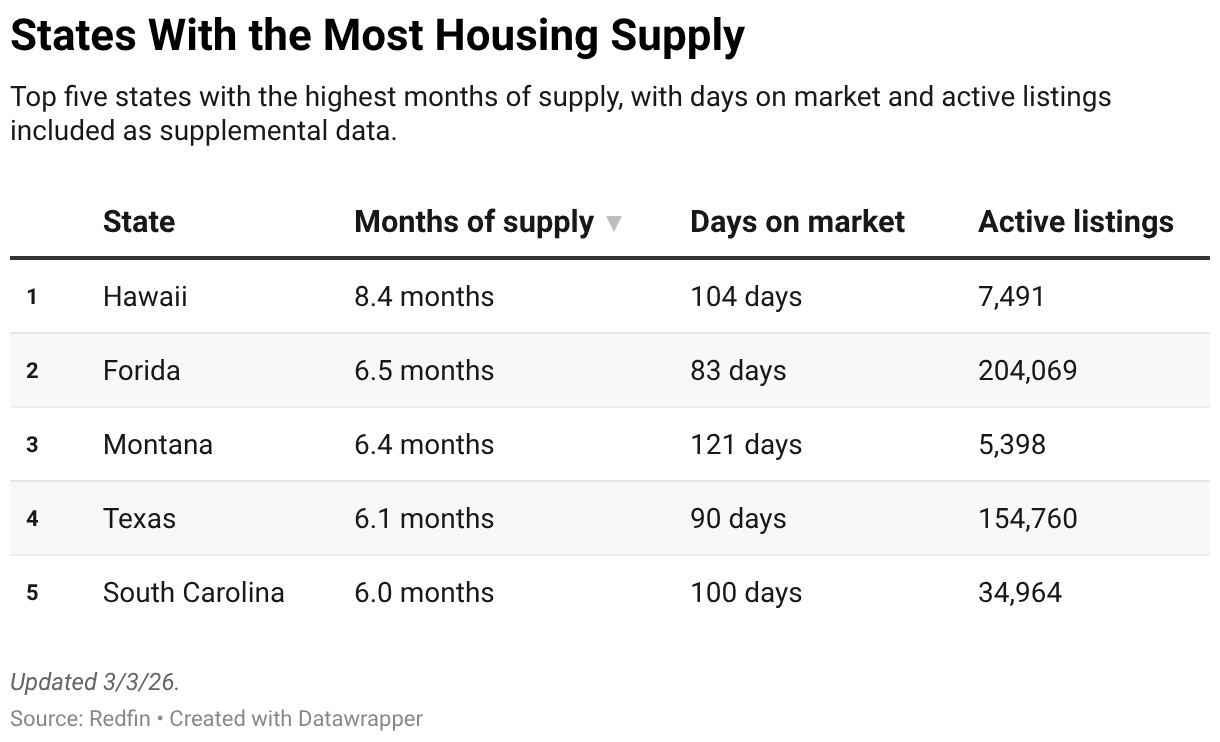
About 1.7 million homes are listed for sale today— historically low, but one of the highest December levels since the pandemic. This is the main driver of today’s buyer’s market. Florida and Texas have the most homes on the market today.

Housing inventory is high because a greater share of sellers are listing their homes than buyers are buying them, with the largest imbalance in disaster-prone areas. in Florida. This gives today’s buyers more options for concessions.

But many sellers are now starting to back out after realizing they can’t get top dollar, which is starting to thin the housing stock. Home building too dived in 2025.

Demand is near an all-time low

Even with lower rates and more homes on the market, buyer demand remains weak due to high home prices and economic uncertainty. yearbook of the National People’s Congress Profile of buyers and sellers of housing confirms this: first-time buyers are older, more cost-conscious, fewer and farther apart.

For buyers on a budget, this can be a good time to enter the market as sellers may be more open to negotiations.

Still there are exceptions. The cities of New York like it Rochester and Buffalogreat demand for available houses pushes up prices and puts responsibility on sellers. Bay Area sees a surge in popularity as well, along with parts of the Midwest.

>> Read: How to Sell Your Home in 2025: The Complete Guide

Inflation may rise

The housing market is critical, economists concerned that inflation may rise due to changes in economic and immigration policy data, which will affect mortgage rates and affordability.

Although inflation has not increased, it is there creeping up and remains above the Fed’s target; experts say it will continue to rise unless policy changes. In fact, a the report found that inflation could have fallen by about one-third if not for tariffs.

Inflation has serious consequences for buyers. The most important thing is this can lead to higher housing prices and mortgage rates, as well as further stretching of budgets. If inflation does pick up, loans could become more expensive, making this a smart move fix the rate before that happens.

>> Read: The housing market under Donald Trump: What it could mean for buyers, sellers and renters

How to buy in an uncertain economy

With tariffs, the economic shock and volatile mortgage rates, many buyers are wary of entering the market. Here are some tips from our economists on how to navigate this changing landscape.

  • Stick to your budget: Now is not the time to stretch yourself financially. The chances of a recession are lower than before, but the economy is still unstable. Make sure you have enough savings to cover your mortgage payments if your income changes.
  • Negotiate, negotiate: The market favors buyers, so use your leverage. The range has become larger, and more and more offers are coming from below.
  • Be smart about bidding: Mortgage rates are falling, but still relatively high. Shop around, compare lenders and ask about “float down” options if the rates drop significantly after you lock in.
  • Sell ​​before you buy: If you own a home, consider selling it first. This will give you a clearer budget and help you avoid the risk of taking out two mortgages.

>> Read: How to buy, sell, or rent a home amid economic uncertainty

is-now-a-good-time-to-buy-a-house 5

Are you ready to buy a home and own it?

When making a home buying decision in today’s climate, you’ll want to think beyond market conditions and focus on your personal circumstances. Here are some personal considerations to keep in mind.

Financial health

Take stock of your current savings, credit scoreand debt levels. You can afford a house? Or makes rent make more sense?

Housing is a long-term commitment, so you’ll need a solid emergency fund – ideally to cover 3 to 6 months’ worth of expenses – for maintenance and contingencies.

Monthly budget

Find out how a mortgage payment at today’s rates can affect your lifestyle. Make sure you are comfortable driving monthly payments, property taxes, insuranceand others home ownership expenses.

Stability of work and location

Buying a home makes sense if you plan to stay put for several years. A stable job or reliable income is crucial to avoid financial stress, especially if house prices or interest rates rise further.

The choice of location is also important. Is your potential home prone to floods, wildfires, or otherwise climate risks? This is especially important today, as insurers continue the fall of homeownership at an alarming rate.

Personal goals and deadlines

Think about life events like starting a family, retiring or moving. These factors can make home ownership either more attractive or potentially more risky if you need to move quickly.

Lifestyle benefits

Home ownership involves ongoing responsibilities, e.g maintenance, repairand property taxes. Ask yourself if you have the time, resources and desire to handle them.

>> Read: Am I ready to buy a house? 8 questions to help you decide

So, is now a good time to buy a home?

If you have the funds and are ready to own a home, now is a good time to do so buy a house. Rates are coming down, but with today’s high prices and volatile economy, it’s hard to predict what affordability will look like down the road. Waiting for rates to fall creates the risk of competition among buyers and subsequent price increases by sellers.

In such an unpredictable market, it’s best to be prepared. Know your budget contact your local agent, get pre-approvedand move quickly when the right home comes up. The longer you wait, the more competition you may see.


[ad_2]

Source link